

LGFC CONVENES NATIONAL CONFERENCE TO ADVANCE LOCAL REVENUE MOBILISATION, IMPROVE SERVICE DELIVERY
- November 2, 2026
- Posted by: lgfc
- Categories: Articles, LGFC News, News and Events
The Local Government Finance Commission (LGFC), in partnership with the Ministry of Finance, Planning and Economic Development, convened the Uganda Local Government Own-Source Revenue Conference 2026 at Hotel Africana in Kampala, bringing together political and technical leaders from Local Governments, Government institutions, development partners, Parliament, the private sector and other stakeholders to explore practical reforms for strengthening local revenue mobilisation and sustainable fiscal decentralisation.
Held under the theme “Strengthening Local Revenue Mobilisation for Sustainable Fiscal Decentralisation and Improved Service Delivery: Advancing Public Financial Management Reforms Beyond Automation,” the conference provided a national platform to assess Local Government revenue performance, examine existing challenges and agree on measures to translate improved revenue administration into increased collections and better services for citizens.
A central message from the discussions was that Local Governments must move beyond dependence on Central Government transfers and fully exploit their legally recognised revenue-raising powers. Own-source revenue is essential for financing local priorities, responding to emerging community needs and complementing conditional and unconditional grants from the Centre.
Local revenue is growing, but significant potential remains untapped
Presenting the state of Local Government own-source revenue, the Commission highlighted progress in revenue mobilisation while drawing attention to the considerable potential that remains unexploited.
According to the Commission’s Local Revenue Performance Report for FY2025/26, Local Government own-source revenue collections increased by 15 per cent, from UGX384.98 billion in FY2024/25 to UGX442.64 billion in FY2025/26. The 176 Local Governments collected UGX303.03 billion, while Kampala Capital City Authority (KCCA) collected UGX139.61 billion.
Despite this improvement, collections remain below the Commission’s UGX1 trillion revenue ambition. The performance report indicates that FY2025/26 collections represented 44.3 per cent of this target, underscoring the need to broaden the revenue base, strengthen enforcement and improve the administration of existing revenue sources.
The discussions identified property rates, Local Service Tax, market dues, trading licences, hotel tax and other non-tax revenue as important areas for improvement. Participants noted that many Local Governments are yet to fully identify, register and assess eligible taxpayers and revenue-generating activities within their jurisdictions.
Property rates featured prominently in the discussions as a sustainable source of revenue. The Commission’s performance report indicates that only 93 of the 176 Local Governments were implementing property rates during FY2025/26. The need to update property registers, improve valuation and assessment, and ensure compliance with the law was therefore emphasised.
Similarly, participants highlighted the need to strengthen Local Service Tax administration and improve the utilisation and management of public markets, where significant revenue potential remains unrealised.
Beyond automation: strengthening institutions, enforcement and accountability
The conference emphasised that digitising revenue administration is an important reform, but technology alone cannot guarantee increased collections. Local Governments must complement automated systems with effective institutional arrangements, reliable taxpayer information, adequate staffing, enforcement of revenue laws and accountability at both political and technical levels.
The Commission’s report showed that UGX306.16 billion was assessed through the Integrated Revenue Administration System (IRAS) during FY2025/26, against which UGX207.71 billion was collected, representing a collection efficiency of 67.8 per cent. This leaves a substantial gap between revenue assessed and revenue actually collected.
Discussions therefore called for stronger enforcement mechanisms, improved management of outstanding arrears, realistic revenue projections and continuous capacity building for Local Government revenue personnel.
The role of political leaders was also highlighted. Elected leaders were encouraged to provide the necessary political support for revenue mobilisation while allowing technical officers to enforce the law professionally and without undue interference. The distinction between political oversight and direct involvement in revenue collection was underscored as essential to strengthening accountability and improving compliance.
The conference further stressed the importance of taxpayer sensitisation and fair, transparent and lawful revenue administration. Local Governments were encouraged to demonstrate the connection between revenue collected and services delivered, recognising that public confidence and willingness to pay are strengthened when citizens can see tangible benefits from their contributions.
Full rollout of IRAS marks an important milestone
A key highlight of the conference was the commissioning of the full rollout of the Integrated Revenue Administration System (IRAS) by the Guest of Honour, the Rt. Hon. Speaker of Parliament.
The milestone marked an important step in the Commission’s efforts to strengthen digital revenue administration across Local Governments. IRAS supports the registration of taxpayers, assessment and billing, payment, reporting and monitoring of local revenue collections, providing a common platform for improving transparency, traceability and accountability.
The Commission emphasised that the next phase of reform must focus on institutionalising the system and ensuring that Local Governments use the information generated to make informed decisions, monitor performance, identify revenue gaps and strengthen compliance.
The conference therefore challenged Local Governments to move from simply adopting automated systems to using them effectively to improve revenue performance and demonstrate results.
Outstanding revenue due to Local Governments
The discussions also brought attention to the need for all funds legally due to Local Governments to be remitted promptly by the responsible Government institutions.
Outstanding property rates owed by Central Government Ministries, Departments and Agencies (MDAs), as well as funds associated with Local Governments neighbouring protected areas, were highlighted as important matters requiring follow-up and accountability.
The Commission called for stronger coordination between Central Government institutions and Local Governments to ensure that statutory obligations are honoured and that revenue due to Local Governments is made available to support service delivery.
The discussions reinforced the principle that strengthening Local Government financing requires not only improving locally generated revenue but also ensuring that all resources due to Local Governments are released in accordance with the law.
Revenue mobilisation must translate into better services
A key panel discussion, held under the theme “Driving Sustainable Public Sector Excellence through Prudent Local Revenue Mobilisation and Expenditure,” examined the relationship between revenue collection, public financial management and service delivery.
The panel brought together representatives from the Ministry of Finance, Planning and Economic Development, Ministry of Local Government, Kampala Capital City Authority, Local Government associations, development partners, civil society and local government practitioners, including experience from the City of Mutare in Zimbabwe.
Participants underscored that improved revenue mobilisation must be accompanied by prudent expenditure management, transparency and accountability. Local Governments were encouraged to prioritise community needs and demonstrate how locally generated resources contribute to the maintenance of roads, management of public markets, waste collection, street lighting and other essential services.
The discussion also highlighted the importance of collaboration among political leaders, accounting officers, technical personnel, Central Government institutions and development partners in strengthening local revenue systems.
Recognising excellence in local revenue mobilisation
The conference also provided an opportunity to recognise and motivate Local Governments that have demonstrated commendable performance in mobilising and managing own-source revenue.
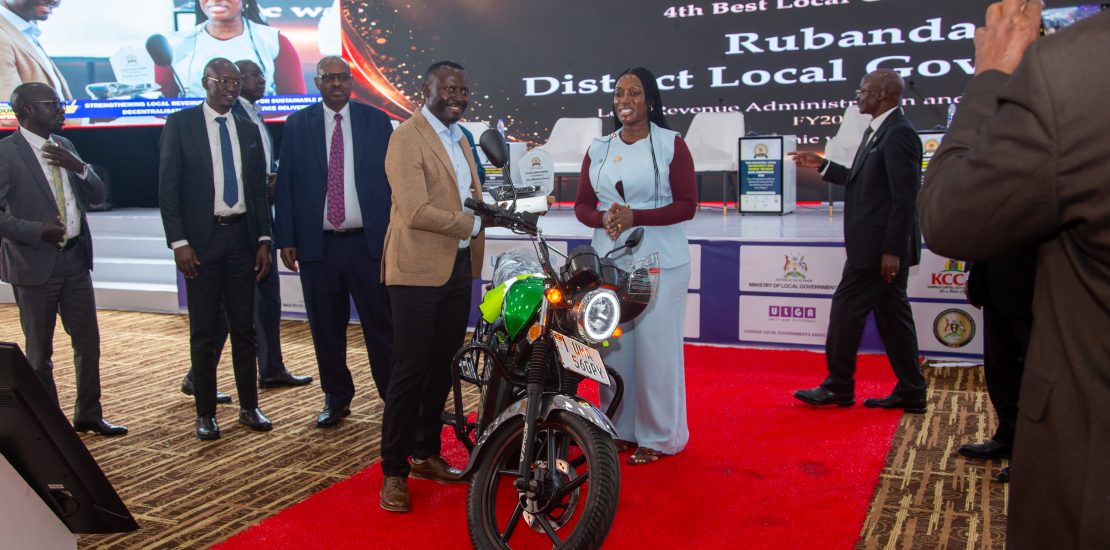
Ten best-performing Local Governments; Arua City, Mbale City, Hoima City, Kiira Municipal Council, Kabale Municipal Council, Nansana Municipal Council, Moyo District Local Government, Lyantonde District Local Government, Mayuge District Local Government, Rubanda District Local Government; were recognised under the Local Revenue Excellence Awards, with the recognition intended to encourage innovation, healthy competition, improved revenue administration and the prudent utilisation of locally generated resources.
The awards underscored the Commission’s commitment to promoting peer learning and sharing successful approaches that other Local Governments can adapt to their respective contexts.
A renewed commitment to sustainable Local Government financing
In closing, the conference reaffirmed the importance of own-source revenue as a foundation for effective fiscal decentralisation and responsive service delivery. Participants called for sustained efforts to strengthen revenue administration, expand the tax base, improve compliance, institutionalise digital systems and ensure accountability in the utilisation of public resources.
The Commission will continue working with the Ministry of Finance, Planning and Economic Development, the Ministry of Local Government, Local Governments, development partners and other stakeholders to strengthen the policy, institutional and technological foundations for improved local revenue mobilisation.
Through its advisory, coordination, capacity-building and technical support functions, the LGFC remains committed to supporting Local Governments to realise their revenue potential and progressively reduce overdependence on Central Government transfers.
The conference reinforced a shared understanding that stronger local revenue systems are not simply about collecting more money; they are about empowering Local Governments to finance local priorities, respond to citizens’ needs and deliver better services.